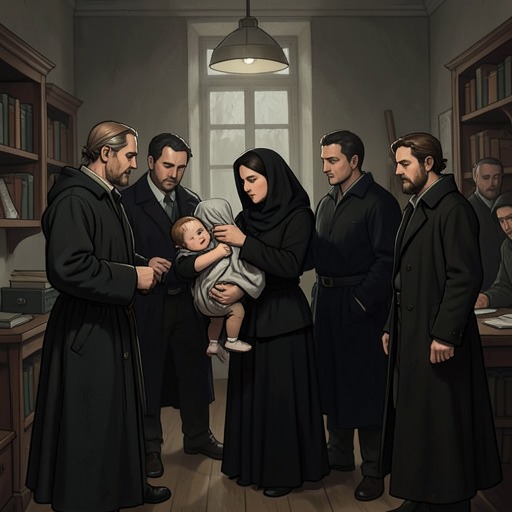
William and Mary’s decree against the Comprachicos
The Man Who LaughsWilliam and Mary’s decree against the Comprachicos is presented as a state campaign against an association accused of buying children and exploiting them. Its importance lies not only in the severe penalties it prescribed, but in the reversal that followed: a law intended to protect children made their presence perilous for some poor, itinerant families, contributing to the abandonment it was meant to prevent.
Political Background and Purpose
The decree followed the change of dynasty in England in 1688, when William III replaced James II. The book contrasts the new king’s policy with his predecessor’s: James II had regarded the Comprachicos as politically useful and had not been hostile to them, while William III, with different ideas and practices, sought to crush the association. Parliament’s measures targeted men and women identified as Comprachicos, also called Comprapequeños or Cheylas. The law thus appears as both a change in royal policy and a criminal measure against a group portrayed as trafficking in children.
Its protective purpose is explicit in the narrative’s account of the statute, but the enforcement problem was broader than proving the guilt of particular child-buyers. The law also made association with a child a source of suspicion. A wandering family could be questioned simply because it had a child with it, and poverty made it difficult for some parents to establish their relationship to the child in ways officials would accept. The decree’s reach therefore extended beyond its named targets: it altered the risks faced by vagabonds and other people forced to travel and beg.
Penalties and Legal Reach
The statute set out a graduated scheme of punishment. Convicted members of the fellowship faced identifying brands, with R, T, and M assigned to the shoulder and hands to signify rogue, thief, and man-slayer. Those identified as chiefs, described as apparently wealthy despite beggarly appearances, could be pilloried and marked on the forehead with a P; their property was also to be confiscated, and trees in their woods rooted up. The law treated failure to inform on the Comprachicos as a separate offence: non-reporters risked confiscation and imprisonment for life.
Women found among the men were assigned the cucking-stool, a forced water punishment. These measures make the decree more than a declaration of prohibition. It sought to mark suspected offenders publicly, remove their property, and enlist the surrounding population in reporting them. The threatened consequences for silence extended the state’s pressure beyond those directly accused and made the law’s operation dependent on denunciation as well as official investigation.
The wider account of English justice helps place that threat within a system where arrest could precede explanation. The narrative notes that unexplained arrests remained common despite the Habeas Corpus Act, especially in cases treated as matters of state. It describes silent arrest as a practice that reserved questions and counselled silence until hidden matters came to light. This is not the same provision as the anti-Comprachicos statute, but it helps explain the atmosphere in which suspicion could be experienced as an immediate danger rather than a distant legal possibility.
Enforcement, Flight, and Abandonment
The law dispersed people. According to the narrative, the measures against the Comprachicos sent not only members of the association but vagabonds of many kinds into flight. Many Comprachicos returned to Spain, and many were Basques. The narrative depicts the resulting movement as a scramble in which each group feared being left behind, while the distinction between the alleged criminals and people merely reduced to wandering became difficult to maintain in practice.
Children became evidence against the adults around them. A child’s presence in a wandering band could itself prompt a sheriff, bailiff, or constable to suspect that the group was made up of Comprachicos, leading to arrest and inquiry. Even people who had done nothing of the kind feared being taken for child-buyers. The threat was especially acute for families whose poverty and itinerant lives made proof of parentage difficult. In the account’s stark causal sequence, the child became a liability: flight seemed easier without one, and some parents chose to lose the child in a wood, on a shore, or in a well. The narrative also notes children found drowned in cisterns.
The law’s unintended consequence is stated directly: a measure for the protection of children initially produced many abandoned children, who were found—or, in the narrator’s sharper formulation, lost. The decree did not simply fail to prevent harm; its enforcement helped create conditions in which adults could believe that abandoning a child was safer than being stopped and questioned. This consequence turns the statute’s stated purpose against its effects, without making the law itself the only cause: poverty, fear of mistaken justice, and the vulnerability of wandering families all contribute to the outcome.
The Portland Child and the Decree’s Limits
The narrative connects this general consequence to the child discovered in the isolation of Portland. Asked who had abandoned him, it answers that, to all appearances, the Comprachicos had done so. The qualification matters: the scene presents an inference, not a witnessed account of the abandonment. The broader discussion of flight and abandoned children gives that inference a social setting, but does not establish that the statute itself directly caused this particular child’s fate.
Later, the child’s identity is disclosed as Lord Fermain Clancharlie, the only legitimate son of Lord Linnæus Clancharlie and Ann Bradshaw and the heir to his father’s estates and titles. The account states that James II ordered him sold at the age of two, after his father’s death, and that he was put out of the way because of his inheritance. This history sharpens the decree’s limits: legislation directed against the Comprachicos could punish the association and unsettle the lives of the poor, while a royal command had already enabled the child’s sale. The contrast does not erase the statute’s stated protective aim, but it exposes how unevenly protection and power operate in the book. The law disperses suspected offenders; it cannot, by itself, undo harm authorized from above or ensure that vulnerable children are safe.